 Imagine websites like Mercedes.Benz, Coca.Cola, Bud.Light, White.House, Disney.World. What if, instead of rolling out a handful of new domain extensions (like the proposed .xxx, .nyc, .web, etc.) each year, all possibilities of domain extensions were instantly available.
In this scenario, instead of picking from existing domain extensions like .com, .net, .org, you could simply choose a name to go before the dot, and a name to go after the dot. You could register Bluth.Company or Moes.Tavern for your business. You could register Kenny.Powers as your personal website or Bedford.Falls for your city. The possibilities are almost endless.
This system could also disrupt current country code values, especially for the less adopted cTLDs. Imagine being able to register .usa instead of sticking to .us. or .britain instead of .co.uk.
One of the reasons that new extensions have been relatively unsuccessful thus far is because it is hard to get the word out to the masses. Each new extension (think .mobi, .tel, .museum, .aero, .jobs or .travel) must face this uphill battle alone and attempt to tell the world that they exist. Years after launch, many people still have never heard of these new extensions that are currently available.
What happens if, instead of attempting to announce every new top level domain extension, the public begins to understand that two words connected by a dot signify a website address.
So how would it work? The new system would be similar to the old system in that you pick the part that goes before/to the left of the dot. Next, instead of choosing from a small list of possibilities for the extension, you would pick whatever you want to go after/to the right of the dot. If the combination was not already taken, you could register it. If the extension to the right of the dot did not exist, it would be created instantly. You could register whatever you want and create any extension you want. Want to register pickle.donkeyknife as your site? Probably not – but you could.

So, would this really be a dot com killer? Maybe eventually, but probably not anytime soon and perhaps not in our lifetime. Even if this new system were possible, global advertising dollars and brands would likely still only promote their .com websites. New TLD extensions have mainly been a footnote in the domain name story thus far and have served to reinforced the importance, trust, authority and value of a .com domain name.
 The .Asia landrush period ended today, and no matter how many press releases I read about it, I still do not get .asia. Don’t get me wrong, I understand what they are saying and it sounds fine on paper. Promoters of .asia say that the Asia/Pacific region is one of the fastest growing online communities in the world. In fact, they say, it contains 60 percent of the world’s population and over 500 million users connected to the internet.
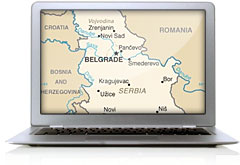 After the dissolution of Yugoslavia (.yu) in the 1990s, the independent country of Serbia and Montenegro (Crna Gora i Srbija in Serbian) was assigned the ccTLD .cs (yes, the same one previously assigned to Czechoslovakia). During this time, the .cs extension was never assigned an operator and was not used. The Republic of Serbia then became an independent state in 2006, after Montenegro (now using .me) left the union. According to documents on the official website (